Thursday, July 26, 2012

Cover Crops: Good for Forage, Too!

This year's drought is especially hard on livestock - there's not much growing for them to munch on. Today we learned that sixty-four Indiana counties are now "primary natural disaster areas" due to the lack of rain, and Conservation Reserve and Wetland Reserve acreage has been opened up for emergency forage and haying.

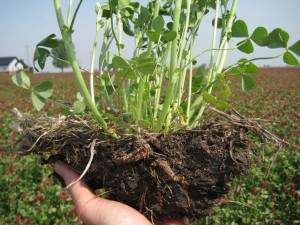
However, according to Dave Robison at PlantCoverCrops.com, "Harvesting cover crops for emergency fall forage may be able to play a major role in lessening the impact of the 2012 drought disaster for livestock producers."

His article is copied in part here; you can read the full version here.
"I have received phone call after phone call from dairy and beef producers asking what cover crops they can use to provide food for their animals this fall and winter. Below I have listed a variety of choices that may work well for producers needing feed (if we get rain). By the way, these choices are also excellent cover crops."

Dave recommends these crops for forage:
  • Sudangrass or Sorghum X Sudangrass
  • Spring Oats/Spring Triticale
  • Oats and Crimson Clover
  • Oats and Cereal Rye (or Winter Triticale)
  • Oats (or Spring Triticale) and Peas (Forage or Austrian Winter Peas)
  • Annual Ryegrass/Annual Ryegrass – Crimson Clover Mix or Italian Ryegrass
  • Spring or Winter Barley

Wednesday, July 11, 2012

Hot, Dry, and Difficult

Drought-stressed corn in Terre Haute, IN.
Photo source.
Drought: "a period of dryness especially when prolonged; specifically one that causes extensive damage to crops or prevents their successful growth" (Merriam Webster). 

As of last week, Indiana is officially the most affected by this year's drought, out of all the corn- and soy-producing states.

The central part of the state may even face mandatory water restrictions, something that naturally-dry states like Arizona are familiar with but are almost unheard of here in normally water-rich Hoosier country. Most of a recent spike in water usage is due to homeowners watering their lawns.

Farmers are seeing the results of all their planning and preparation turn not green, but brown and yellow.

Though this year may end up as a loss in the books, it's far from time to throw in the towel. This year is one that will test us and provide us with valuable information & experience for any future difficult years.

NRCS and the Purdue Extension have compiled some very timely and useful websites for those looking for advice and information. 

For farmers, consider this "silver lining:" Remaining nutrients in the soil can be captured for use next year. Purdue scientists and NRCS agronomists agree that most of the nitrogen (a commonly-applied fertilizer) will not be used by the crops this year. As such, it is wise to consider planting a cover crop, which will store the residual nitrogen for future use.

For homeowners, remember to water your lawn and gardens when the sun isn't shining, at most once per week, and consider setting out a bowl of water for thirsty neighborhood wildlife and pets.

Wednesday, June 20, 2012

Walk the Path that Water Walks

Pathway to Water Quality (PWQ) is a model watershed showing how land "sheds" water, or drains to a common place such as a river, lake or stream. We all live in a watershed and what we do each day impacts our soil and water quality.

Is soil an important ingredient in your every day life? The answer is yes, and here are a few reasons why:

  • Last night you slept in a building built on soil.

  • You drink water that flows through soil and is cleaned by the soil.

  • You breathe air that comes from plants growing in the soil.

  • You even wear clothes made from plants that grow in the soil.

Pathway's education area offers great conservation
activities for youth and the young at heart.
Soils make our lives possible. We also play on soil, drive on soil, eat food grown in or raised on soil, and take medicines from soil. The entire earth — every ecosystem, every living organism — is dependent upon soils.

Did you know one teaspoon of soil contains more living organisms than all the known kinds of plants on earth? Creatures like mammals, reptiles, amphibians, worms, insects, spiders, centipedes, mites, nematodes, plants, fungi, bacteria and microbes — all help keep the soil healthy and rich for crops, gardens, wildlife, food, and people.

Pathway to Water Quality exists to show the connection between healthy soils and clean water, why it is important, and what we can do at home and on the farm to protect our soil and water quality !

For more information on PWQ visit our website at
www.pathwaytowaterquality.org.

Thursday, June 7, 2012

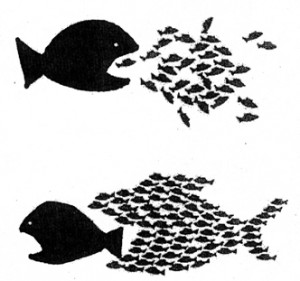
"If You Want to go Far, Go Together"

Earlier this week I read a quote I can't stop thinking about: "If you want to go fast, go alone. If you want to go far, go together." I couldn't find a person to whom I can ascribe the quote, but I think it's powerful and very applicable to what Soil and Water Conservation Districts (SWCDs) do.

In Indiana, we rely on the resources and passions of many different agencies, organizations, and individuals in order to improve the health of our environment. Although each group or person works to accomplish individual goals quickly and efficiently, working with other agencies across the state have allowed us all to "go far."

The Indiana Conservation Partnership, which is comprised of the Association of SWCDs, the Natural Resources Conservation Services, the Indiana Department of Environmental Management,  the Farm Service Agency, the Indiana Department of Natural Resources, and others, works together to solve our common natural resource problems. We all have different resources and different limitations (some of us are nonprofits, some are government agencies; some are locally-based and some are statewide) and it is our differences that enable and inspire us to combine our strengths to build a better, healthier Indiana.
Organize!

The Partnership's goals for all Hoosiers include:
  • Clean drinking water
  • Cleaner streams, rivers and lakes for recreation
  • Productive soils for Indiana’s farmers
  • Enhanced quality of life for Indiana citizens
  • Stronger state economy
  • Funded local District programs
  • Funded local cost-share programs

Together, we seek out and receive funding for conservation projects in Indiana (like Clean Water Indiana and Conservation Reserve Program funding). We share the expertise of staff members in order to provide the best possible information and experience to each other and to Hoosiers who take advantage of our services. We appreciate a familiarity and camaraderie with one another that contributes to a stronger Partnership that is more capable of providing high-quality service to Indiana.

Though working together instead of working alone has its unique challenges and progress seems slow at times, our Partnership has allowed us to come much further than we ever could alone.

See what we have accomplished in your county.


Thursday, May 17, 2012

Indiana Wildlife Federation Recognizes CCSI & LaPorte SWCD

The Indiana Wildlife Federation serves our state through "promoting the conservation, sound management, and sustainable use of Indiana's wildlife and wildlife habitat through education, advocacy, and action." Like the IASWCD, and our 92 local Soil and Water Conservation Districts, IWF works with state agencies and similar organizations. They monitor and work to improve and protect Indiana's wildlife and habitats, which are made up of the natural resources SWCDs work to protect as well.

Last weekend, IWF recognized the work of two Soil and Water Conservation District entities: one program called the Conservation Cropping Systems INitiative (CCSI) and one standout staff member, Nicole Messacar (Education Coordinator for the LaPorte Co. SWCD).

CCSI received the Agriculture Conservation Award "for its work promotinv environmentally-friendly farming techniques." Nicole earned the Conservation Educator of the Year award for the work she does to educate children about wildlife and conservation.

We are proud to work with these award winners, and excited to celebrate our positive relationship with the Indiana Wildlife Federation! Conservation is something that concerns all of us. Though we work differently, our goals are similar - to protect this land for now, and for future generations.

Thursday, May 10, 2012

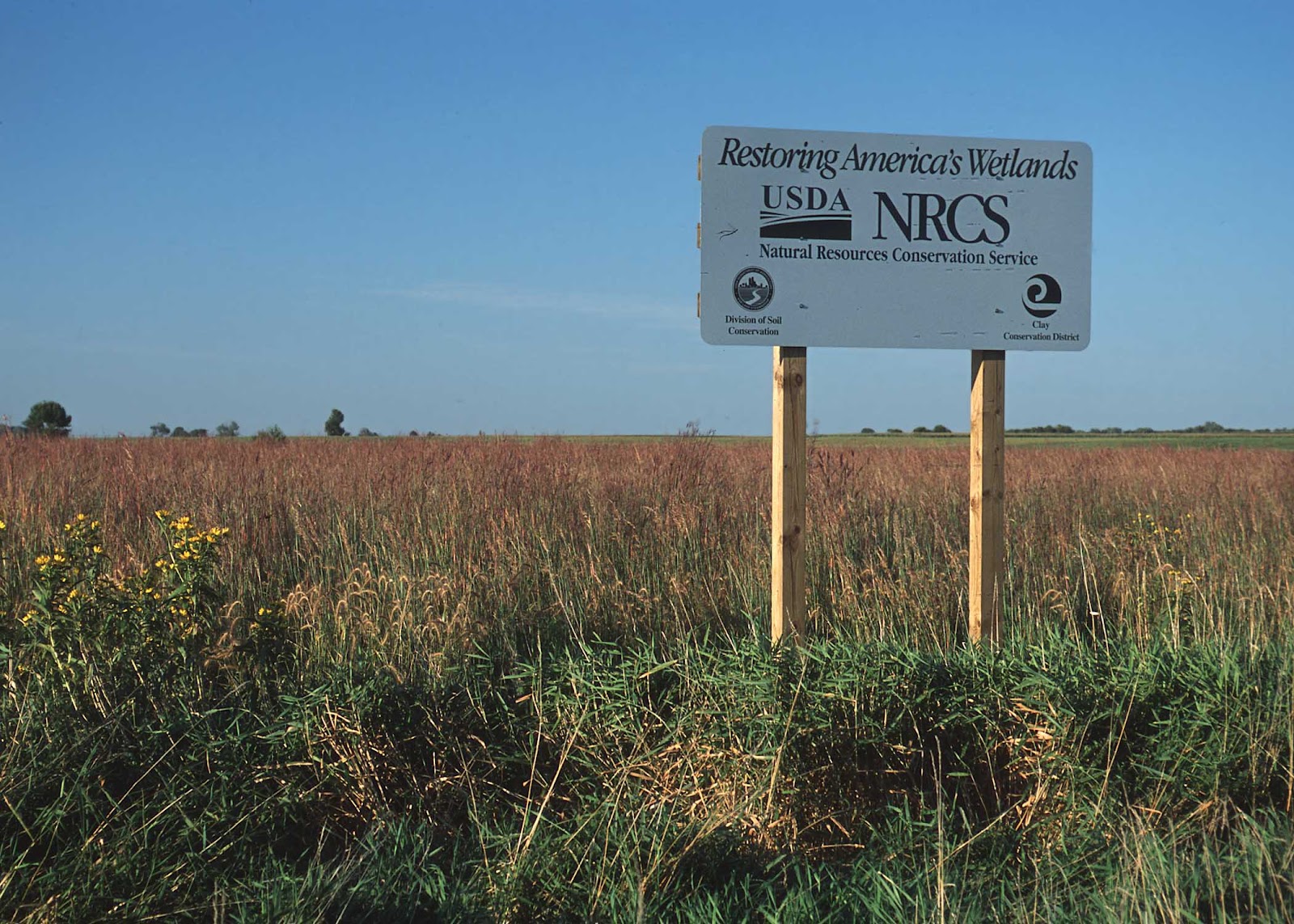
May is American Wetlands Month

Photo credit: Natural Resources Conservation Service
May marks the 22nd anniversary of American Wetlands Month. It is a time when we all should celebrate the vital importance wetlands play in our world protecting our soil and water resources.

It is also a great opportunity to teach others about the important role wetlands play in our environment and the significant benefits they provide — improved water quality, increased water storage and supply, reduced flood and storm surge risk, and critical habitat for plants, fish, and wildlife.

Wetlands are the vital link between land and water, where the flow of water, the cycling of nutrients, and the energy of the sun meet to produce highly productive ecosystems with unique plant and animal life.

Wetlands are often referred to as the "kidneys" of the landscape for their ability to remove excess nutrients, toxic substances, and sediment from water that flows through them, helping to improve downstream water quality. Natural wetlands have also been effective in removing contaminants such as pesticides, landfill liquids, dissolved chlorinated compounds, metals, and stormwater runoff.

Wetlands play an important role in reducing the frequency and intensity of floods by acting as natural buffers — slowing, absorbing, and storing significant amounts of floodwater. Since flooding is the most common natural hazard in the nation, wetlands play an integral role in managing this risk, particularly through planning approaches that consider the entire watershed.

The presence of wetlands on the landscape can also mitigate flood damage inland. A study by the Wetlands Initiative concluded that restoring wetlands along the 100-year flood plain of the Upper Mississippi River could increase storage capacity to 39 million acre-feet of flood water--a similar volume to the Mississippi Flood of 1993 that caused $16 billion in damages.

The ability of wetlands to store and filter water helps to protect and replenish surface and underground drinking water sources.

As nurseries of nature, wetlands are among the most biologically productive natural ecosystems in the world, comparable to rain forests and coral reefs in their productivity and in the diversity of species they support. Mixtures of vegetation and shallow water zones provide diverse habitats for a variety of species — plants, insects, amphibians, reptiles, birds, fish, shellfish, and mammals. Many species rely on these critical habitats for survival as sources of food, shelter, and breeding grounds.

For example, frogs, toads, and salamanders depend on small, isolated wetlands during their development. It is estimated that one-half of all North American bird species nest or feed in wetlands, and despite the fact that wetlands comprise only 5% of the land surface in the conterminous United States; they are home to an estimated 31% of plant species.

Source: U.S. EPA

Wednesday, May 2, 2012

Soil Stewardship Week

Jane Hardisty
by Jane Hardisty
State Conservationist, Indiana NRCS
When you picked up your spoon to eat some food today, did you think about where the food came from? Did you make a connection as you ate a bowl of cereal to the dairy and grain farmer? Or the hay or grain the dairy cow ate? Or the fact that the grain and hay grew in the soil? We sometimes take for granted that it’s so easy to go to the grocery store to buy our food. But it’s a long process to get the food from the soil to the grocery store shelf.


National Soil Stewardship Week is April 29 through May 6, 2012, and the theme this year is “Soil to Spoon.” Keeping the soil healthy is a primary focus of the agency I work for, the USDA Natural Resources Conservation Service (NRCS). Our agency is working hand-in-hand with Indiana’s 92 Soil and Water Conservation Districts every day to help farmers and private landowners improve soil health and protect natural resources.

The world population is on the rise, while agricultural land is shrinking. A careful balance will be required to make more room for more people, while at the same time, more food to feed those people. Healthy soil and good conservation choices can ensure we have the resources we need for now and for generations to come. 

Making the connection back to the soil, where our food gets its start is so important. The next time you sit down to a meal, take a minute to think about where your food came from, and the farmers and ranchers who helped produce it. As they work to produce food for the growing population, Indiana’s farmers are dedicated to using responsible land-management practices to ensure a sustainable food supply and healthy land and soil for future generations. Please join me in thanking our local agriculture producers for their role in caring for the land, while providing the food and fiber for our nation and the world.

National Soil Stewardship week reminds us of our personal and social responsibility to care for the natural resources for which we all depend. There is a Soil and Water Conservation District in each county in Indiana where NRCS and other partnership staff are available to serve you and help you make the connection between soil and the food we eat.