Tuesday, June 11, 2013

All the Buzz: the Importance of Pollinators to our Food Supply

Pollinators come in several shapes and sizes, although the most-well known are the several varieties of bees and butterflies we encounter during warm weather. Plants depend on pollinators to fertilize them and spread their seeds. Without their hard work about one-third of our food supply would be drastically affected.

According to the EPA and Agriculture Department, honey bee colonies have been dying and the number of colonies has more than halved since 1947. This decline has increasingly been reported in the news (here, here, and here for examples); scientists have dedicated careers to studying its causes (like the Xerces Society); and it has even gotten attention on Capitol Hill. The problem of disappearing pollinators isn't one that can be solved by a "silver bullet" solution, though, as the known causes of the decline are numerous. This list is in no particular order:

  • Improper and over-use of pesticides and herbicides
  • Parasites
  • Reduced habitat
  • Climate change
  • Limited genetic diversity in American bees leaves them weaker to variations in their environment (EPA)
  • Competition to native plant species from invasive ones
  • Lack of floral diversity
As an aside, domesticated bee colony numbers are on the rise (source).

Agricultural producers are very aware of the decline of pollinators - especially bees. Inputs such as pesticides, combined with limited ecological diversity and crop rotation, contribute to the decline of pollinators. Producers and conservationists combat this by using ag practices that improve biodiversity and pollinator habitat on their farms, plant cover crops, rotate their cash crops, use practices that reduce the need for pesticide and herbicide applications, and more. Read more about what farmers can do to help pollinators.

Landowners can promote pollinator habitat and survival through several practices. Planting flowering native plants, reducing or outright declining to use pesticides and herbicides, and creating nesting areas through leaving patches of ground bare, installing nesting blocks, and planting caterpillar host plants. Learn more from the Xerces Society.

Wednesday, May 15, 2013

(Mis)Conceptions about Soil Health

by Logan Garner
Indiana State Department of Agriculture
Program Manager, Water Quality Initiatives
logarner@isda.in.gov

Unless you are involved in agriculture in Indiana, you may not have heard the term “soil health.” We are fortunate to live in a state where so many farmers are focusing on the improvement of our soils, and are adopting the concept that healthy soils mean good things for their crops, their wallets and the natural resources which sustain both.

Still, not every farmer sees the benefits of building soil health. There are some misconceptions about soil health as a goal which may give the impression that it does not apply to them. For instance, some growers still ask, “if I put nutrients in my soil, then isn’t my soil healthy?”

While putting nutrients on the ground does allow for greater nutrient availability to plants, it does not improve the soil’s inherent ability to function. Soil health is not just about how much Nitrogen, Phosphorus or Potassium is available to a crop, but how well the soil as an ecosystem exchanges those nutrients, how well it allows water (and nutrients and air) to infiltrate below the surface of the ground, and how much water holding capacity lies within the soil’s structure.
 
An excellent gauge of all these abilities is the organic matter in the soil. This is ultimately a measure of carbon in the soil. Some soils have more and some have less, but there’s a lot more to it than that. When carbon levels in the soil rise, it means that things are living and metabolizing there. Bacteria, insects, earthworms and fungi all play specific roles in helping nutrient exchange and availability for plant roots to tap into, and the more, the better!

Building organic matter also allows pores (or holes) in the soil to hold their structure, which means more water can flow through the soil, and more water fills those pores. Another way to say all this is “better infiltration and greater water-holding capacity leads to better water availability to the crop.” The improved infiltration also results in less runoff, less soil loss and reduced flooding.

If all this is true, then why isn’t everyone doing it? There’s no quick answer to this. First and foremost, there is little formal research on soil health. A search of academic journals quickly shows that the term “soil health” is just that—a term. However, the important role of organic matter in a soil’s capacity to sustain crops is well known by ag researchers.

While this lack of research data on soil health may seem like a small hurdle to those who see the readily visible and practical benefits from building soil health, it’s a flag to individuals who want to “see the numbers” before exploring the issue. So as conservationists, we should be asking the question differently. For example, “If given the choice between soil with low organic matter and soil with high organic matter, which one would you choose?” I don’t think a single person would pick the first choice. This same argument can be made for other issues that compromise soil health and long term sustainability (such as soil compaction and soil erosion). 

Ultimately, soil health is not about conservation program enrollment. It’s not about participation in cropping initiatives. Healthy soil is the result of a system of conservation cropping practices, such as no-till and a cover crop regimen. These are all tools (excellent ones, at that) which will help to reach the goal of building soil organic matter which is inherently good for production, the economy and the environment.

Bottom line — building soil health comes about through the process involved in building organic matter--keeping living plants in the soil as long as possible and keeping the soil surface covered with residue year round.

For more information on soil health, contact members of the Indiana Conservation Partnership, a collaboration of eight groups supporting on-the-ground agricultural and urban conservation practices across the state. They can be found at the ICP website: http://www.iaswcd.org/icp/index.html and their cooperative program, the Conservation Cropping Systems Initiative at: http://www.iaswcd.org/CCSI/ccsi.html.


Friday, April 26, 2013

WHIP and Hunting: A True Story

Perry County Soil & Water Conservation District Supervisor, farmer, and conservationist Jim Fiedler sent us this inspiring story about a fifth-grader bagging her first turkey. The turkey flock was attracted to Wildlife Habitat Incentive Program (WHIP) land - acreage that had been preserved specifically to attract wildlife and all the benefits it brings to a farm's ecosystem.

Jim writes, 
"Miss Kayla is 11 years old and in the 5th grade at Perry Central Elementary and an avid hunter. The Turkey was measured at Michael’s Market’s check in. It weighed 25 pounds with an 11 inch beard and 18 mm spurs. I know that is big but a turkey hunting enthusiast who has hunted all over the country...told me he has only killed two that big: one 25 pounds and one 26 pounds. (I believe the Indiana state record may be 25 pounds!)

"Kayla killed her first deer last fall but did not even take a photo because it was too ‘small’. This certainly makes up for it! Her dad, Bert took her hunting on Saturday which was the first day of youth hunting. But it was late after he got home. So he got home earlier the next day on Sunday and took her to the blind they had set up on my property on the far edge of the big field in front of my house.

"There were several turkeys in the field and they started coming toward their blind but they became spooked and turned back. Bert decided it was late and left Kayla alone in the blind while he went for his truck. He heard the shot and Kayla yelled, 'I got the son of a gun!' as he walked to the truck! So it definitely was her turkey all by herself. She used a single shot 20 gauge shotgun...and is having a full mount of the turkey to keep in the corner of her bedroom!

"Here is an interesting side note about the field where she shot it. The 40 acre field was planted in cover crops last fall as part of the government WHIP (Wildlife Habitat Incentive Program) for drought relief for farmers. I think an 11 year old girl killing her first turkey while the flock was feeding on WHIP acreage is just what [the conservation program] intended. She should be the poster person!

"Kayla is very modest and did not at first want to be seen ‘bragging’ about killing a turkey but decided it was okay when she understood how it can encourage others [to value conservation]."

Conservation's values and rewards aren't limited to farmers. Wildlife, hikers, hunters, bird-watchers, pollinators, scientists, young people, teachers - the list goes on, but the point is that conservation's benefits are realized not just by the folks who are responsible for its implementation on their lands, but by all of us.

Learn more about conservation and hunting by checking into organizations such as Ducks Unlimited and Pheasants Forever. Learn more about ecologically and personally responsible and ethical hunting from organizations like Orion, the Hunters' Institute and the Indiana DNR's safety course.

Celebrating Stewardship in Indiana

Stewardship Week kicks off on Sunday, April 28. The theme this year is "Where Does Your Water Shed?" The purpose of having a week dedicated to learning about and celebrating stewardship gives us the opportunity to remember our own commitment to protecting our resources, as well as show off our accomplishments and announce our goals and expectations for the coming challenges.

In Indiana, our abundant natural resources are truly something to celebrate, as are the women and men who work tirelessly to protect and improve them. Farmers who value the sustainability of their operation and the long-term health of their land; scientists who are committed to determining the best practices for conservation, improving water quality, and soil health; community members dedicated to making sure their neighbors are aware of the value and benefits of conservation; the elected or appointed leaders of the state who make sure conservation issues are given a voice; and volunteers who go above and beyond to be good stewards of the land in all capacities.

Inspiring stories can be found in all corners of the state. One of my favorites comes from the southeast, an area known for old coal mines, freeway construction projects, and low-lying river bottom land. In this instance, invasive weeds had totally dominated an area of an abandoned, exposed surface mining project. A local man, dedicated to restoring the land's integrity, worked with all sorts of companies, government agencies, and neighbors to eradicate acres of kudzu, honeysuckle, tree of heaven, and other rampantly-growing invasive plants. It involved renting heavy machinery, hours and hours of time, and a sustained commitment to seeing it through.

In another story, closer to our office's home in Indianapolis, a section of a parking lot at the Indiana State Fair was reclaimed in order to build a model of a healthy watershed. Crazy idea, huh? The crazier thing is that twenty years later it's still there, attracting hundreds of visitors and learners each year. Pathway to Water Quality was featured in the February issue of My Indiana Home - check out the article here. This coming Tuesday, we'll be reading a proclamation recognizing Stewardship Week and the value of watersheds out at PWQ with members of the Indiana Conservation Partnership and state government.

What is your commitment to stewardship? Make sure to let your community know! Any time is good, but this coming week - Stewardship Week - is particularly good.

Wednesday, March 27, 2013

For The Sake Of Soil, Sustainability and Profits, Just Say "No" To Tillage

Spring tillage is a tradition that is steeped deeply into American agriculture. But more and more producers are realizing that this iconic tradition is costing them – in more ways than one.

Tillage, which was once considered necessary in order to prepare a proper seed bed for planting, comes at a high price in terms of increasing diesel prices and labor costs. But according to Barry Fisher, a soil health specialist with USDA’s Natural Resources Conservation Service in Indianapolis, the bigger, long-term cost may come at the expense of the health and function of the soil itself – resulting in lower yields, higher input costs and reduced drought resiliency for Indiana farms.
Barry Fisher at a field day.
Photo credit: PlantCoverCrops.com

“Tillage is incredibly destructive to the soil structure and to the soil ecosystem,” Fisher said. “In healthy soil you have 50 percent air and water – which is made possible by the pore space in the soil – and 50 percent mineral and organic matter. But tillage collapses and destroys that structure, making the soil vulnerable to erosion and compaction,” he said.

The possibility of another dry year should also have producers rethinking their use of tillage, Fisher said. “Because it destroys organic matter and soil structure, tillage actually reduces the soil’s infiltration capacity,” he said. “Additionally, studies have shown that each tillage pass can release a half an inch of soil moisture from each acre. In short, tillage tends to limit the availability of water in the soil,” Fisher said. “And that could prove very costly during those long, summer dry spells.”

Fortunately, more and more producers in Indiana are farming with systems to build soil health, Fisher said. “Using a suite of conservation practices, like quality no-till and diverse cover crops,” he said, “they’re keeping living plants in the soil as long as possible and they’re keeping the soil surface covered with residue year round.”

And according to Fisher, the benefits of improved soil health extend beyond the farm. “Producers who improve the health of their soil are also increasing its water-holding capacity, which reduces runoff that can cause flooding. Improved infiltration keeps nutrients and sediment from being carried off-site into nearby lakes, rivers, and streams,” he said.

Producers interested in learning more about the basics and benefits of soil health, or in receiving technical and financial assistance to implement a soil health management system, should contact their local NRCS office www.in.nrcs.usda.gov/contact/directory/field_offices.html. Additional soil health information is available at www.nrcs.usda.gov.

Barry Fisher is a soil health specialist with USDA’s Natural Resources Conservation Service in Indianapolis.

Tuesday, March 5, 2013

March: Indiana Ag Appreciation Month and Women's History Month

There's an old saying about March: "In like a lion, out like a lamb." As I type a snow-rain-ice storm seems to be creeping up on our office in Indianapolis. Ugh. Hopefully the old maxim holds true.

Despite the weather, March is an important month for many. Across the state, March has been designated as a day to celebrate Indiana Agriculture (we're kicking it off today at the Statehouse!) Across the nation, March 19 will be given to celebrating all our country's food & fiber producers, and the land that we rely on for our sustenance. March is also Women's History Day in the United States. The day of March 8, this Friday, is celebrated as International Women's Day for the past 105 years.

What about Women in Agriculture?

The USDA's Farm Service Agency states:
"Women are key to the development of rural areas through their contributions to sustainable agriculture and rural development, including food security, but women are often marginalized in the agricultural sector, do not share equal status at the banks or within the agribusiness sector, and often do not fully participate in USDA programs and services."
The Food and Agriculture Organization of the United Nations states:
"Farmers. Workers. Entrepreneurs. Care-givers. Bread-winners. Bread-makers. Mothers. Wives. Daughters. Women are the backbone of the rural economy, especially in the developing world. Yet they receive only a fraction of the land, credit, inputs (such as improved seeds and fertilizers), agricultural training and information compared to men. Empowering and investing in rural women has been shown to significantly increase productivity, reduce hunger and malnutrition and improve rural livelihoods. And not only for women, but for everyone."
Despite these upsetting, yet very real statements, strides towards empowering women in agriculture are increasing with every passing year and generation. For those who follow international development and food security, you can no doubt call to mind some of the leaders of the slow revolution: Vandana Shiva, Muhammad Yunus & Grameen Bank, Kiva, etc. Powerful international organizations such as the United Nations and the World Bank have also focused their efforts on highlighting the importance of women's roles in agriculture and stable societies, with the UN's FAO reporting that having equal access to agricultural resources could reduce world hunger by 12-17%.

The revolution that's taking place across the country—the feminine approach to farming—might be enough to save the future of food, according to Temra Costa [in] Farmer Jane: Women Changing the Way We Eat. Photo: Rodale Institute
In the United States, the number of women who own farm operations increased by 19% between 2002 and 2007 (source). In that same time period, the number of women who are principal farm operators rose as well. National and regional women's organizations have grown as well. Close to home, Indiana is the site of the Purdue Women in Ag Conference. Nationally, several exist. Here are some:


There's much too much to write about all the exciting facets of the intersection between women and agriculture in one blog post - which is a good problem to have! Indulge your curiosity by checking out these infographics and articles:


Friday, December 14, 2012

Apps for Modern Agriculture


Apps. 

They're everywhere. Even if you don't own a smartphone or a tablet, you can't have missed all the buzz around these new tools and toys.

Though it's perceived that most apps are developed for young urbanites, creatives, and tightly-scheduled business people, many apps have come out that are especially relevant and useful for agriculture-related purposes. Apps to aid in precision farming, determine soil types, and plant identification are widely available. Check out this list of ag apps, from our Soil Health Program Manager Lisa Holscher:

  • FieldScripts – from the Monsanto Integrated Farming Systems
  • LandView – We understand Becks has been providing some growers with iPads and the application. They’re doing a lot of field scouting using the program
  • AdaptN - From Cornell University, this app uses climate information to calculate N needs. Especially useful for farmers who side-dress.
  • GreenIndex – This app aims to help verify chlorophyll content in the field (you could also use a hand-held GreenSeeker). This could be a great companion to AdaptN.
  • Weed ID Guide – from University of Missouri Extension
  • 1000 Weeds of North America - Fairly self-explanatory.
  • Aphid Speed Count – An app to help count aphids on soybean plants. How fun!
  • SoilWeb - This lets users access digital soil survey data from USDA’s Natural Resources Conservation Service (NRCS).

Monday, October 29, 2012

The Power of Conservation: Today's Actions, Tomorrow's Rewards


The Power of Conservation. We use this phrase frequently in the soil and water arena.

The simple act of conserving our natural resources is, in my mind, a very powerful daily job that Soil and Water Conservation Districts and our Indiana Conservation Partners are deeply committed to.

It is an act that each one of us hopefully does every day in some way, whether we live on a farm, in a large urban environment, or a small town.


Right now that power of conservation can be seen in action across Indiana farm fields as cover crops are taking hold, setting deep roots into our Hoosier soils. Cover crops, that will protect the soil over the winter, provide rich nutrients and fertilizers for spring crops while improving and preparing the soil for spring planting.

The power of conservation is visible in neighborhoods all over Indiana on any given day as recycling bins are set curbside for trash pickup, or as leaves and other fall garden debris are collected and composted.

The rewards are forthcoming. Some are in the short-term. Many will be seen years down the road. We all have a stake in today's actions, because they affect tomorrow's rewards.

If you are committed to our soil and water resources, join us January 7-9, 2013, for The Power of Conservation: Today's Actions, Tomorrow's Rewards. It is the 70th Annual Conference of Indiana Soil and Water Conservation Districts at the Indianapolis Downtown Marriott.

You'll find 12 excellent hands-on training sessions, keynote speakers, and exhibitors designed to provide you with the tools you'll need for The Power of Conservation: Today's actions, Tomorrow's Rewards.

Register today!

Monday, October 15, 2012

Guest Post: Drought Provides Opportunities to Improve Soil Health

Guest post contributed by Joe Kelsay, Indiana Agriculture Director and owner of Kelsay Farms

This year's historical drought has provided a prime opportunity for a special focus on a most precious resource, our soil. Though we tend to think first of the extreme weather's effect on our 2012 crop yields, its impact on feed supplies and the health of our fields could easily extend the damage into next season and well beyond. ISDA encourages our farmers to minimize this impact by spending some time this fall considering their opportunities to improve soil health.

One way to address soil health and make the most of these conditions is through the establishment of cover crops like oats, clover, rye grasses, and/or radishes. These can provide emergency forage, reduce soil loss, scavenge precious nutrients, improve water quality, offer wildlife habitat and rehabilitate pastures, all while developing soil health at the same time.

Cover crops improve soil health by creating more organic matter in the ground and increasing water-holding capacity. They help to reduce soil compaction and erosion, and can ultimately suppress weed pressure while increasing the yields of subsequent crops. They can also provide critical forage for grazing, chopping or haying at a time when livestock producers everywhere are facing cost-related challenges and having to reassess how to manage feed sources for their animals.

As evidence to the interest in cover crop benefits from our farmers, we witnessed overwhelming response to emergency cover crop cost share assistance from recent announcements of federal and state programs. In spite of the fact that the interest from Indiana landowners proved to be much greater than the availability of funds, many landowners are choosing to continue with these conservation efforts on their own. There are a host of resources that can assist these efforts, including the Conservation Cropping Systems Initiative (CCSI), Purdue University Extension, the Natural Resources Conservation Service (NRCS), Soil and Water Conservation Districts (SWCD's) Certified Crop Advisors (CCA's) and numerous online chats, blogs and message boards, just to name a few.

Much time will be invested in the recovery from this year's drought, and we will find solutions to minimize the challenges of 2012, with a deliberate focus on improving our soil. Many different avenues can offer help, arming producers with the essential tools they need to get to the best position for the future.  What is most exciting is that Indiana has proven over and over again that by focusing on our strengths and constantly innovating, especially in difficult times, we continue to propel Indiana Agriculture forward.

Tuesday, October 9, 2012

Why Weren't We No-Tilling Until Now?

Excerpted from an interview with Conservation Cropping Systems Initiative coordinator Hans Kok:

Q: When did we determine no-till was better?

The 1960s. We didn't have the technology . . . it's that simple. We couldn't seed in the ground with this much trash or residue on the surface and we couldn't control the weeds. That's why we were doing tillage. It's not that we were doing things so wrong, it's that we were using 1700's technology. We've progressed, but it always takes a long time for new technology to be adopted.

Now in other places in the world, they've adopted no-till like crazy. Australia, New Zealand, Argentina, Brazil ... they are almost entirely no-till out there, so they've taken the technology, they've seen the value of it, they money it saves the farmers to go no-till and realizing we have the tools. But here in the States, we've been slow to adopt it, and in Europe it has been even slower.

But with something like this educational tool (the rain simulator) it shows what happens the value of no-till. It wakes a lot of people up. A farmer came up to me in Kansas and said he saw my rain simulation a couple of years ago and started thinking about it what we were doing to the land and switched the whole farm over to no-till. I've yet to meet a farmer, topography or soil type or climate where we can't no-till.


Tuesday, August 14, 2012

Destroying Crops? Don't Till!

Many crops have been lost this year due to the drought. For those farmers who have crop insurance, they may consider destroying the crop or putting what remains to alternative uses, such as harvesting it as silage or feed. Before crops are destroyed, an insurance agent needs to verify that the crop was indeed lost.

But how does one destroy a crop without harming the land underneath it, and while keeping an eye to the future? A common misconception among farmers and insurance agent is that tillage is necessary to destroy a crop. However, tilling your land can have very harmful effects that will last longer than this season, as dry as it is. 

Consider the destruction tillage would cause to the soil's health; nutrients left unused by the crop will run off and drastically reduce water quality; the increase in erosion due to exposed soil; and that any remaining moisture would evaporate quickly from tilled fields.

The Risk Management Agency has clarified that tilling is not required to destroy a crop. Instead, consider using it for pasture, bush hog, set it for silage, etc. Corn stalks with ears yet on them can be left standing as forage. 

Additionally, growers who have nothing to harvest this season can consider planting a cover crop that also serves as forage. The forage could then be used or sold to a neighbor.

Remember - "Destroy" Does Not Mean "Till"

Thursday, July 26, 2012

Cover Crops: Good for Forage, Too!

This year's drought is especially hard on livestock - there's not much growing for them to munch on. Today we learned that sixty-four Indiana counties are now "primary natural disaster areas" due to the lack of rain, and Conservation Reserve and Wetland Reserve acreage has been opened up for emergency forage and haying.

However, according to Dave Robison at PlantCoverCrops.com, "Harvesting cover crops for emergency fall forage may be able to play a major role in lessening the impact of the 2012 drought disaster for livestock producers."

His article is copied in part here; you can read the full version here.
"I have received phone call after phone call from dairy and beef producers asking what cover crops they can use to provide food for their animals this fall and winter. Below I have listed a variety of choices that may work well for producers needing feed (if we get rain). By the way, these choices are also excellent cover crops."

Dave recommends these crops for forage:
  • Sudangrass or Sorghum X Sudangrass
  • Spring Oats/Spring Triticale
  • Oats and Crimson Clover
  • Oats and Cereal Rye (or Winter Triticale)
  • Oats (or Spring Triticale) and Peas (Forage or Austrian Winter Peas)
  • Annual Ryegrass/Annual Ryegrass – Crimson Clover Mix or Italian Ryegrass
  • Spring or Winter Barley

Wednesday, July 11, 2012

Hot, Dry, and Difficult

Drought-stressed corn in Terre Haute, IN.
Photo source.
Drought: "a period of dryness especially when prolonged; specifically one that causes extensive damage to crops or prevents their successful growth" (Merriam Webster). 

As of last week, Indiana is officially the most affected by this year's drought, out of all the corn- and soy-producing states.

The central part of the state may even face mandatory water restrictions, something that naturally-dry states like Arizona are familiar with but are almost unheard of here in normally water-rich Hoosier country. Most of a recent spike in water usage is due to homeowners watering their lawns.

Farmers are seeing the results of all their planning and preparation turn not green, but brown and yellow.

Though this year may end up as a loss in the books, it's far from time to throw in the towel. This year is one that will test us and provide us with valuable information & experience for any future difficult years.

NRCS and the Purdue Extension have compiled some very timely and useful websites for those looking for advice and information. 

For farmers, consider this "silver lining:" Remaining nutrients in the soil can be captured for use next year. Purdue scientists and NRCS agronomists agree that most of the nitrogen (a commonly-applied fertilizer) will not be used by the crops this year. As such, it is wise to consider planting a cover crop, which will store the residual nitrogen for future use.

For homeowners, remember to water your lawn and gardens when the sun isn't shining, at most once per week, and consider setting out a bowl of water for thirsty neighborhood wildlife and pets.

Wednesday, June 20, 2012

Walk the Path that Water Walks

Pathway to Water Quality (PWQ) is a model watershed showing how land "sheds" water, or drains to a common place such as a river, lake or stream. We all live in a watershed and what we do each day impacts our soil and water quality.

Is soil an important ingredient in your every day life? The answer is yes, and here are a few reasons why:

  • Last night you slept in a building built on soil.

  • You drink water that flows through soil and is cleaned by the soil.

  • You breathe air that comes from plants growing in the soil.

  • You even wear clothes made from plants that grow in the soil.

Pathway's education area offers great conservation
activities for youth and the young at heart.
Soils make our lives possible. We also play on soil, drive on soil, eat food grown in or raised on soil, and take medicines from soil. The entire earth — every ecosystem, every living organism — is dependent upon soils.

Did you know one teaspoon of soil contains more living organisms than all the known kinds of plants on earth? Creatures like mammals, reptiles, amphibians, worms, insects, spiders, centipedes, mites, nematodes, plants, fungi, bacteria and microbes — all help keep the soil healthy and rich for crops, gardens, wildlife, food, and people.

Pathway to Water Quality exists to show the connection between healthy soils and clean water, why it is important, and what we can do at home and on the farm to protect our soil and water quality !

For more information on PWQ visit our website at
www.pathwaytowaterquality.org.

Thursday, June 7, 2012

"If You Want to go Far, Go Together"

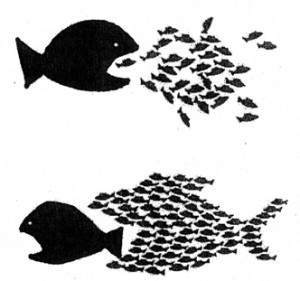
Earlier this week I read a quote I can't stop thinking about: "If you want to go fast, go alone. If you want to go far, go together." I couldn't find a person to whom I can ascribe the quote, but I think it's powerful and very applicable to what Soil and Water Conservation Districts (SWCDs) do.

In Indiana, we rely on the resources and passions of many different agencies, organizations, and individuals in order to improve the health of our environment. Although each group or person works to accomplish individual goals quickly and efficiently, working with other agencies across the state have allowed us all to "go far."

The Indiana Conservation Partnership, which is comprised of the Association of SWCDs, the Natural Resources Conservation Services, the Indiana Department of Environmental Management,  the Farm Service Agency, the Indiana Department of Natural Resources, and others, works together to solve our common natural resource problems. We all have different resources and different limitations (some of us are nonprofits, some are government agencies; some are locally-based and some are statewide) and it is our differences that enable and inspire us to combine our strengths to build a better, healthier Indiana.
Organize!

The Partnership's goals for all Hoosiers include:
  • Clean drinking water
  • Cleaner streams, rivers and lakes for recreation
  • Productive soils for Indiana’s farmers
  • Enhanced quality of life for Indiana citizens
  • Stronger state economy
  • Funded local District programs
  • Funded local cost-share programs

Together, we seek out and receive funding for conservation projects in Indiana (like Clean Water Indiana and Conservation Reserve Program funding). We share the expertise of staff members in order to provide the best possible information and experience to each other and to Hoosiers who take advantage of our services. We appreciate a familiarity and camaraderie with one another that contributes to a stronger Partnership that is more capable of providing high-quality service to Indiana.

Though working together instead of working alone has its unique challenges and progress seems slow at times, our Partnership has allowed us to come much further than we ever could alone.

See what we have accomplished in your county.


Thursday, May 17, 2012

Indiana Wildlife Federation Recognizes CCSI & LaPorte SWCD

The Indiana Wildlife Federation serves our state through "promoting the conservation, sound management, and sustainable use of Indiana's wildlife and wildlife habitat through education, advocacy, and action." Like the IASWCD, and our 92 local Soil and Water Conservation Districts, IWF works with state agencies and similar organizations. They monitor and work to improve and protect Indiana's wildlife and habitats, which are made up of the natural resources SWCDs work to protect as well.

Last weekend, IWF recognized the work of two Soil and Water Conservation District entities: one program called the Conservation Cropping Systems INitiative (CCSI) and one standout staff member, Nicole Messacar (Education Coordinator for the LaPorte Co. SWCD).

CCSI received the Agriculture Conservation Award "for its work promotinv environmentally-friendly farming techniques." Nicole earned the Conservation Educator of the Year award for the work she does to educate children about wildlife and conservation.

We are proud to work with these award winners, and excited to celebrate our positive relationship with the Indiana Wildlife Federation! Conservation is something that concerns all of us. Though we work differently, our goals are similar - to protect this land for now, and for future generations.

Thursday, May 10, 2012

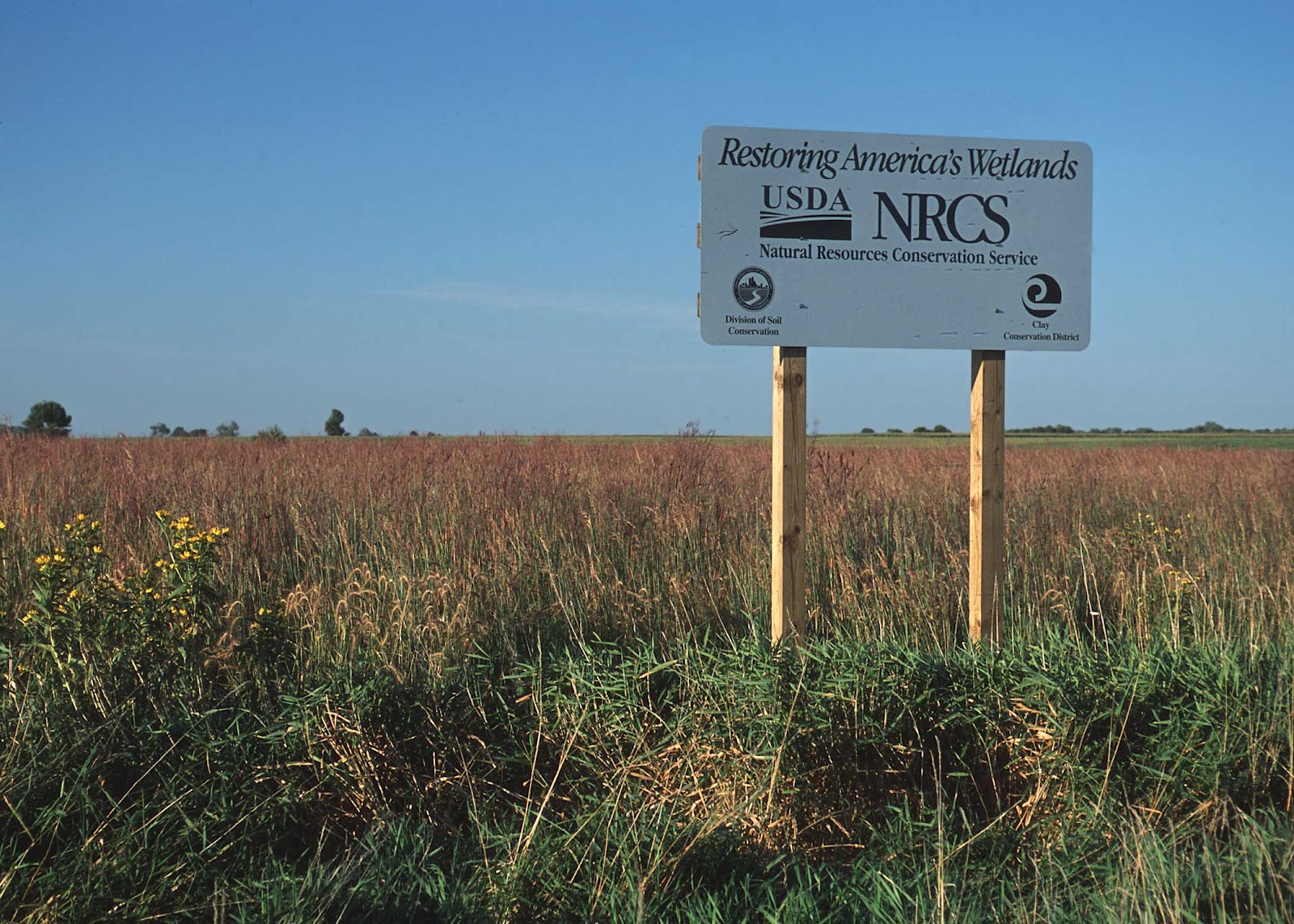
May is American Wetlands Month

Photo credit: Natural Resources Conservation Service
May marks the 22nd anniversary of American Wetlands Month. It is a time when we all should celebrate the vital importance wetlands play in our world protecting our soil and water resources.

It is also a great opportunity to teach others about the important role wetlands play in our environment and the significant benefits they provide — improved water quality, increased water storage and supply, reduced flood and storm surge risk, and critical habitat for plants, fish, and wildlife.

Wetlands are the vital link between land and water, where the flow of water, the cycling of nutrients, and the energy of the sun meet to produce highly productive ecosystems with unique plant and animal life.

Wetlands are often referred to as the "kidneys" of the landscape for their ability to remove excess nutrients, toxic substances, and sediment from water that flows through them, helping to improve downstream water quality. Natural wetlands have also been effective in removing contaminants such as pesticides, landfill liquids, dissolved chlorinated compounds, metals, and stormwater runoff.

Wetlands play an important role in reducing the frequency and intensity of floods by acting as natural buffers — slowing, absorbing, and storing significant amounts of floodwater. Since flooding is the most common natural hazard in the nation, wetlands play an integral role in managing this risk, particularly through planning approaches that consider the entire watershed.

The presence of wetlands on the landscape can also mitigate flood damage inland. A study by the Wetlands Initiative concluded that restoring wetlands along the 100-year flood plain of the Upper Mississippi River could increase storage capacity to 39 million acre-feet of flood water--a similar volume to the Mississippi Flood of 1993 that caused $16 billion in damages.

The ability of wetlands to store and filter water helps to protect and replenish surface and underground drinking water sources.

As nurseries of nature, wetlands are among the most biologically productive natural ecosystems in the world, comparable to rain forests and coral reefs in their productivity and in the diversity of species they support. Mixtures of vegetation and shallow water zones provide diverse habitats for a variety of species — plants, insects, amphibians, reptiles, birds, fish, shellfish, and mammals. Many species rely on these critical habitats for survival as sources of food, shelter, and breeding grounds.

For example, frogs, toads, and salamanders depend on small, isolated wetlands during their development. It is estimated that one-half of all North American bird species nest or feed in wetlands, and despite the fact that wetlands comprise only 5% of the land surface in the conterminous United States; they are home to an estimated 31% of plant species.

Source: U.S. EPA

Wednesday, May 2, 2012

Soil Stewardship Week

Jane Hardisty
by Jane Hardisty
State Conservationist, Indiana NRCS
When you picked up your spoon to eat some food today, did you think about where the food came from? Did you make a connection as you ate a bowl of cereal to the dairy and grain farmer? Or the hay or grain the dairy cow ate? Or the fact that the grain and hay grew in the soil? We sometimes take for granted that it’s so easy to go to the grocery store to buy our food. But it’s a long process to get the food from the soil to the grocery store shelf.


National Soil Stewardship Week is April 29 through May 6, 2012, and the theme this year is “Soil to Spoon.” Keeping the soil healthy is a primary focus of the agency I work for, the USDA Natural Resources Conservation Service (NRCS). Our agency is working hand-in-hand with Indiana’s 92 Soil and Water Conservation Districts every day to help farmers and private landowners improve soil health and protect natural resources.

The world population is on the rise, while agricultural land is shrinking. A careful balance will be required to make more room for more people, while at the same time, more food to feed those people. Healthy soil and good conservation choices can ensure we have the resources we need for now and for generations to come. 

Making the connection back to the soil, where our food gets its start is so important. The next time you sit down to a meal, take a minute to think about where your food came from, and the farmers and ranchers who helped produce it. As they work to produce food for the growing population, Indiana’s farmers are dedicated to using responsible land-management practices to ensure a sustainable food supply and healthy land and soil for future generations. Please join me in thanking our local agriculture producers for their role in caring for the land, while providing the food and fiber for our nation and the world.

National Soil Stewardship week reminds us of our personal and social responsibility to care for the natural resources for which we all depend. There is a Soil and Water Conservation District in each county in Indiana where NRCS and other partnership staff are available to serve you and help you make the connection between soil and the food we eat.

Monday, April 30, 2012

We celebrate stewardship every day

Are you ready for Stewardship Week? The 57th NACD Soil and Water Stewardship Week started yesterday, April 29 and runs through Sunday, May 6! This year's theme is "Soil to Spoon.”

The theme highlights the importance of knowing where your food comes from. The National Association of Conservation Districts could not have selected a more appropriate theme.

That is why the Indiana Association of Soil and Water Conservation Districts and our 92 Soil and Water Conservation Districts and our great Indiana Conservation Partnership (ICP) work so hard to promote the "soil to spoon" story.

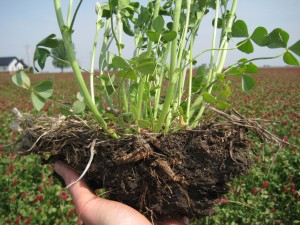
A sample of some very healthy soil protected
by cover crops over the winter from a farmer's field.
Cover crops protect against water and wind erosion and
improve soil quality.
The story begins with soil health and that is something we take very seriously here in Indiana. Simply, we believe maintaining soil health . . . whether it’s our vast acres of farmland across Indiana, or the soil in the yards, greenways and parks of our cities, towns and suburbs . . . it is all essential to protecting our natural resources.

The Conservation Cropping Systems INitiative (CCSI), and ICP program, helps Indiana farmers by promoting a systematic approach to production agriculture. CCSI specialists encourage the adoption of long-term continuous no-till practices on farmland, along with cover crops, nutrient and pest management and precision-farming technology, and the use of conservation buffers.

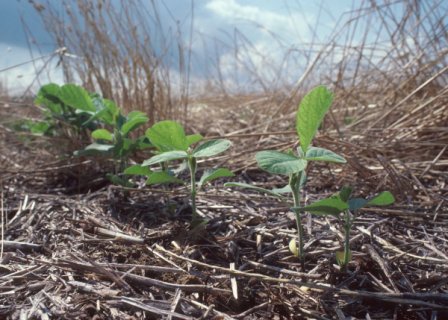
Hamilton County farmer Rodney Rulon is
planting soybeans into cereal rye, a cover crop.
Rulon is a Supervisor for the Hamilton County Soil and
Why?

Because it is providing us with: clean water to drink, and healthy soil to grow food and feed

And, that's good stewardship.


Monday, April 16, 2012

Show Pride in Your Produce with "Indiana Grown"

In late March, the Indiana State Department of Agriculture (ISDA) announced the new Indiana Grown program. Its goal is to enable consumers to easily identify, find, and buy Indiana-grown products. Through connecting producers - farmers, ranchers, nurseries, etc - processors, wholesalers, retailers and ISDA, Indiana Grown will brand and promote Hoosier produce and production.

If your product was grown in Indiana, your operation could be included in the Indiana Grown Program. If you would like to be a member, ISDA is accepting applications. It's a simple and straightforward app. If it is accepted, you can use the attractive Indiana Grown logo (shown above) for a full year to help promote your products and show your Hoosier pride. According to ISDA, "This program encompasses everything from a big farming operation to a small roadside stand."

The program categories are:
  • Produce, Field Crops, Forestry
  • Dairy (BOAH permits must be submitted to ISDA)
  • Eggs (must submit egg permit license from Purdue University, Indiana Egg Board)
  • Livestock & Livestock Products (Processed Meat & Poultry Products, Beef Cattle)
  • Fish & Seafood
  • Ornamental Horticulture (Greenhouse Nursery, Floriculture & Turf Grass)
You can apply here.

Other news stories on Indiana Grown:
"This Old Farm, Indiana Grown" - video via WishTV
"Indiana Grown program to boost state's farm goods" - via the Indianapolis Star