Monday, March 26, 2012

Green Manure is a Gardener's Best Friend

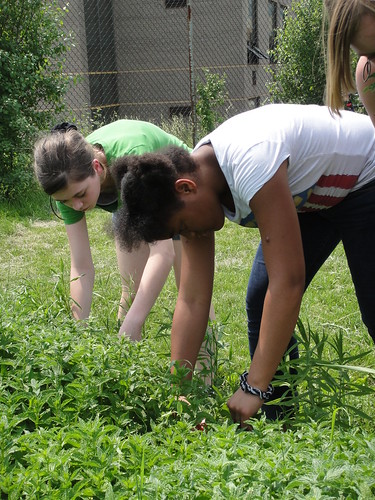
Photo courtesy of Agrarian Adventure
My mom has been putting some early-spring plants from the greenhouse into the ground. She'll be growing spinach, lettuce and kale this season, as do many home gardeners this time of year. While many gardeners may already use a fertilizer of some sort - from manure, to compost, to chemicals- one form of living fertilizer, cover crops, is making headlines in home gardening. Check out the features from these widely-read publications: Garden.org, MotherEarthNews.com, and TLC's HowStuffWorks.

Our friends at the West Central Indiana Watershed Alliance have just released their spring newsletter: the Home Gardening Issue. It cautions home gardeners to be wise about their fertilizer use (it all drains into our common water supply) and also has some excellent information on those looking to start using cover crops - aka Green Manure.

WCIWA writes: "Cover crops...are an excellent tool for vegetable gardeners, especially where manures and compost are unavailable. They:

  • lessen soil erosion during the winter
  • add organic matter when turned under or used as mulch in the spring
  • improve soil quality
  • suppress weeds
  • create and cycle soilborne nutrients"
What a list! No wonder Michelle Obama uses cover crops (annual rye is at least one) to help out the South Lawn's soil. 

WCIWA also reminds home gardeners that: "Information on the use of cover crops is typically tailored to the needs of farmers working on large acres. But when you measure your cropping space in feet rather than acres and your main tools have wooden handles, you need a special set of cover crop plants and  special methods for using them." After all, if you were going to knit a sweater, you wouldn't take your tips from J.Crew's factories; you'd use information from a smaller-scale resource.

Here's a fantastic video from the popular series Cooking Up A Story. In it, Master Gardener Jen Aron shows how she uses cover crops in her home garden.

WCIWA recommends these resources for the gardeners:

Tuesday, March 20, 2012

Indiana's Leading Agricultural Trends


Barry Fisher, state agronomist for NRCS
Did you know that Hoosiers, among all the great food-producing states, are actually leading the way in agriculture? That's right - Indiana farmers have received accolades from across the board, from Federal government representatives (NRCS Chief Dave White) and fellow neighbors and farmers. With support from their local Soil and Water Conservation Districts, the uniquely Hoosier Conservation Cropping Systems Initiative and the Indiana Conservation Partnership, Hoosier farmers have shown that using conservation-forward agricultural practices is good for their land, good for their crops, and good for their businesses.

Did you know Indiana has more cover crops than the rest of the nation combined?

NRCS states that Indiana farmers' focus on soil health is is notable. "Indiana success with this approach, being promoted through the Conservation Cropping Systems Initiative, is getting national attention and will be a focus of NRCS this year."
Hans Kok of CCSI holding 
a sample of a  popular cover crop: 
oilseed radish 

"Soil Health is soil managed to its maximum potential through a system of conservation practices, including never-till, cover crops, advanced nutrient and pest management, and buffers and drainage systems where appropriate. This approach results in healthy soil that reduces erosion, requires less nutrient inputs, manages the effects of flood and drought, and reduces nutrient and sediment loading to streams and rivers." (NRCS)

Indiana farmers certainly have a lot to be proud of! Contact your local SWCD for more information on how to keep this state - and the land we depend on - great.

Thursday, March 15, 2012

Managing Phosphorus Shortages With Conservation

Phosphorus is a nutrient that is used ubiquitously in fertilizers. It has an amazing ability to improve crop yields. Much of the Green Revolution, which is credited with having saved hundreds of thousands of people from starvation, utilized it and nitrogen extensively to boost agricultural production.

But where does phosphorus come from? It is not created in a lab, and it's not a renewable resource. In fact, we mine for it. The most productive mine in the US is located in Florida, and it is  growing depleted. The other concentrations of phosphorus are found in the Middle East, China, and South Africa.

The price of phosphorus reflects its increasing shortage: according to Foreign Policy, phosphate fertilizer rose 350% between 2003 and 2008. It has become much more expensive to continue increasing crop yields through phosphorus.

However, in recent years an increasing focus on conservation agriculture and more efficient fertilizer application processes have provided food producers with ways to continue maintaining high crop yields even as phosphate fertilizer costs rise and supply decreases. Phosphorus can be used over and over again (it's not destroyed after one use), and most methods focus on keeping the fertilizer in the soil. These are long-term conservation agriculture solutions that maintain soil health. Low-tech solutions include methods of reducing soil erosion (cover crops, no-till farming) and high-tech solutions like using computers to more accurately measure the amount of fertilizer soil needs and the creation of more phosphorus-efficient crops.

If you are interested in how you can improve your soil's health and your farm's efficiency through conservation agriculture, contact Indiana's widely-recognized Conservation Cropping Systems Initiative. 

Tuesday, March 6, 2012

Rain Barrels: Coming Soon to an SWCD Near You!


Have you seen one of these on a neighbor's property? Did you find yourself curious? Well wonder no longer: this post is all about rain barrels, one of which is pictured to the right.

When it rains, we have a number of ways to deal with the water: from gutters and drains, to rain gardens and sewage systems. One popular rainwater storage tool for individuals is a rain barrel. Many Soil and Water Conservation Districts in Indiana, and across the country, sell rain barrels.

Did you know that until June 2009, rain barrels were illegal in Colorado? The state ruled that all water that fell belonged to it. Colorado sells much of its water supply to nearby dry or high-water-use states, primarily California. It's still illegal to catch rainwater in Utah, unless you own water rights on the land upon which it falls. In New Mexico, however, it's mandatory for new buildings to have rainwater harvesting infrastructure. Luckily for Hoosiers, harvesting rainwater is a welcomed conservation practice.


The water caught by rain barrels is used for everything imaginable, even drinking (if it's properly purified). Here are some popular rain barrel uses:
  1. Reduce water mains' water use, for economic or environmental reasons
  2. Aid self-sufficiency 
  3. Watering gardens
  4. Agriculture
  5. Flushing toilets
  6. In washing machines
  7. Washing cars
  8. Drinking (assuming the barrel owner purifies the water)
  9. In ground rainwater tanks can also be used for retention of stormwater.
  10. In drier regions, water can be stored for the drought seasons.
If you decide to get a rain barrel, make sure to keep it and the gutters to which it's connected clean, and make sure the barrel itself is in good repair. Check out Rain Barrel Maintenance 101.

Did you know? 1 inch of rain on a 1,000 square-foot roof will yield 623 gallons of water. Here's a tool to see how large of a rain barrel you might need.

Check with your local SWCD to see if they sell rain barrels, or if they could direct you to a nearby vendor. Have fun conserving water!


Wednesday, February 29, 2012

It All Starts With Soil

There are so many cool things about soil! Without it, we wouldn't have good food, good water, good land to build on, or. . . well, really we wouldn't have much of anything without soil. In this blog post I'm going to run over some of the more tangible aspects of soil, and how it affects you every day.

Recently I read an entertaining and interesting article on The Atlantic that discusses how just smelling soil can boost serotonin (the feel-good chemical your body naturally produces) in your brain. Isn't that amazing? We're genetically inclined toward enjoying being close to the earth! I suspect this is not surprising for many of you. :-)

You know that earthy smell and taste you get especially from certain vegetables grown under soil, like carrots? The smell, called "geosmin" by scientists, lends the sought-after flavor depth to foods.

Another cool thing I learned is that different soils produce different-tasting foods. A tomato from Paraguay will taste differently than an Indiana tomato, simply because they were grown in different soils; a Cabernet from Chile will taste different from a California Cabernet. Cooks call the flavor variations due to the soil in which foods were grown "terroir." The unique bacteria, microbes, and other inputs into the growing land all affect the final product.

On the flip side, a cantaloupe grown in an area with poor soil health - one that has had nutrients leached out of it by any number of poor soil management techniques - will be inferior to one grown in healthy, rich soil.

What this all comes down to is that Everything Starts With Soil. Our very livelihood: our food security; our city and town development; our culture; our natural resources, be they forests, fields, or waterways; they are all profoundly influenced by the health of an area's soil. Land management is soil management.

Learn more about how you can improve and protect your soil's health with the help of your local Soil and Water Conservation District. Click here for a listing of Indiana's 92 county offices.

The Natural Resources Conservation Service also has a wide range of resources for learning about Indiana's soil health, and our strategy for preserving it. Check it out here.

Monday, February 20, 2012

No-Till, No Problem!

No-till field after heavy rain
(with cover crops).
Photo credit: Farm Progress
One of the top recommendations of Indiana's Soil and Water Conservation Districts for farmers is to no-till their land. That's right - put down the plow and let your land take care of itself. It is scientifically proven that no-till farming can be more profitable than traditional tilling methods. (source). The trick is doing no-till correctly, and identifying which practices are best for each farmer's unique operation and land needs.
"Utilizing no-till farming practices has been consistently identified as a method which is capable of conserving soil moisture, reducing soil erosion, improving water quality, benefiting wildlife, increasing labor use efficiency, limiting machinery investments, sequestering atmospheric carbon dioxide, etc." (source)
Tilled field with standing water
after heavy rain.
Photo credit: UW-Discovery Farms
One of the reasons that traditional farm operations will till their land is to, ostensibly, reduce soil compaction. When soil is compacted, it is difficult for crops' roots to punch through the soil and take up the nutrients they need. However, tilling land is time-consuming and expensive, given the machinery and fuel needed to cover acre after acre. Conservation farmers and scientists have found that no-till fields, especially when paired with cover crops, resist compaction.

This article in No-Till Farmer lists some tips for managing soil compaction. Among them are keeping living roots (cover crops) in the soil year round, not driving on fields (or using low-psi flotation tires) and keeping cattle out of fields.

No-tilled fields perform admirably when paired with other conservation farming methods, like cover crops. For example, as noted in Farm Progress, "No-till builds up soil phosphorus levels in the top couple inches of soil. In a run-off event, soluble P losses can be substantial. That's why the practice still needs to be matched with other conservation practices such as buffer zones and cover crops."

Hoosier farmers are lucky to have a unique resource available: the Conservation Cropping Systems Initiative (CCSI). In conjunction with SWCDs, CCSI "promotes a systematic approach to production agriculture focusing on:
  1. Continuous no-till/strip-till
  2. Cover crops
  3. Precision farming
  4. Nutrient and pest management
CCSI works with private producers as well. If you're interested in learning more about how no-tilling your fields can improve your operation, contact your local SWCD today. You can also visit a cover crop field day. Use CCSI's calendar to search for an event in your area.

Wednesday, February 15, 2012

Rain Gardens - the Natural Way to Manage Runoff

It's fairly common knowledge that surface runoff in urban areas can overload sewage and drainage systems; contribute to erosion; contribute to pollution of local water sources; and, of course flooding. Urban areas have lots of impervious surfaces (that don't soak up rainwater) like parking lots and roads, and the natural areas that would normally help manage excess water are diminished.

IU students going to class during the floods of 2008.
Photo credit: IU News Service
When I was living in Bloomington, IN and wading through swamped streets after periods of heavy rain on my way to class and work, I learned first-hand what kinds of problems poor drainage systems can cause! Although it was fun to canoe around Dunn Meadow and kayak down the rapids of the Jordan "River" for a couple days during the floods of 2008, many adjacent communities were declared federal emergency areas and are still dealing with the aftermath. The city was generally bogged down for periods of time after other heavy rains, which leads one to wonder how it could better manage its rain overflow problem.

Urban rain garden.
Photo credit: U. of Rhode Island
One solution can be rain gardens. Rain gardens have been a hot topic in the conservation world for the past few years. The EPA cites rain gardens as a successful way to manage runoff on their stormwater case studies. Essentially, they are a special sort of garden that is designed specifically to absorb water runoff - naturally. The water is stored in the soil. They're also more aesthetically pleasing than a drain, or a flooded sewer!

Rain gardens were first developed in residential areas in 1990 in Maryland. After a few years of studying their effectiveness, they proved to be "highly cost effective."
"Instead of a system of curbs, sidewalks, and gutters, which would have cost nearly $400,000, the planted drainage swales cost $100,000 to install. This was also much more cost effective than building BMP ponds that could handle 2-, 10-, and 100-year storm events.Flow monitoring done in later years showed that the rain gardens have resulted in a 75–80% reduction in stormwater runoff during a regular rainfall event (source)"
If you're interested in learning more about rain gardens, Indiana's Hamilton County SWCD will be hosting a Rain Garden Workshop on Feb. 28. Check out our calendar for details.